SSIC Codes in Singapore: How to Choose the Right One

An SSIC code is a 5-digit number from the Singapore Standard Industrial Classification that you pick on Bizfile to describe your business. Choose the one matching the activity that earns the most, and add a second only if a separate activity is significant.
An SSIC code is a 5-digit number from the Singapore Standard Industrial Classification that every ACRA-registered entity must pick to describe what it does. You choose it on Bizfile when you reserve your business name. The rule for getting it right is simple: pick the code for the activity that earns the most, and add a second code only if a separate activity is genuinely significant.
What an SSIC code is
The Singapore Standard Industrial Classification is the national system for classifying business activities. It is maintained by the Department of Statistics (DOS), which revises it roughly every five years, and it is used across government — in censuses, surveys and administrative registers. When you incorporate, your chosen code becomes part of your company’s public business profile.
All ACRA-registered entities must use 5-digit SSIC codes for their:
- Primary business activity, and
- Secondary business activity, where applicable.
Importantly, the code is a description, not a licence or a restriction. Picking one activity does not stop your company from carrying out others; it simply records your main line of work for official purposes.
Where you choose it
You select your SSIC code when you reserve a business name on Bizfile. In the name application, under Business activity, you enter a keyword, search, then pick one code for your primary activity and — if relevant — one for your secondary activity.
If you want to settle on a code before you log in to file, the GoBusiness e-Adviser for Starting a Business lets you search the classification (now based on SSIC 2025) and get step-by-step guidance first. Both tools are free and official.
Primary vs secondary: go by value added
Your primary (principal) activity is the one that contributes the most to your company’s value added — broadly, the activity that generates the most income or value, not the one you spend the most time on. DOS puts it plainly: where value added is hard to measure, you can fall back on gross output, revenue or sales, or the share of employment and wages.
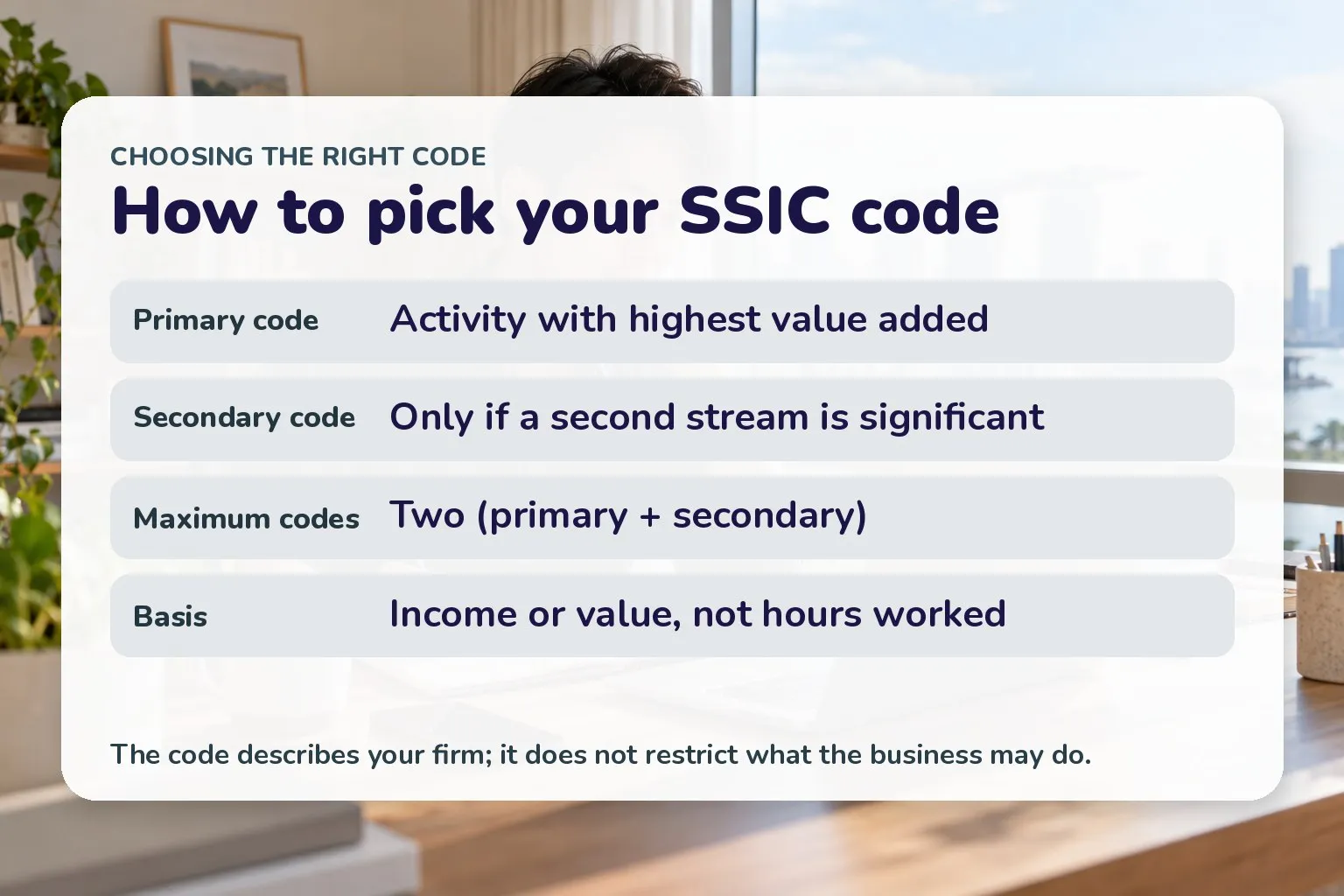
How ACRA and DOS say to pick your SSIC codes. Source: ACRA and SingStat, as of October 2026.
A common example: a founder who spends most of the week writing software but earns most of the revenue from consulting retainers should register the consulting activity as primary, because that is where the value added sits. A secondary activity is a separate activity producing goods or services for others that is not your principal one — add it only when that second stream is substantial.
How the 5 digits are structured
SSIC is hierarchical: each extra digit narrows the activity from a broad section down to a specific sub-class. Reading an example from DOS, a semiconductor wafer business maps like this:
| Level | Title | Code |
|---|---|---|
| Section | Manufacturing | C |
| Division | Manufacture of computer, electronic and optical products | 26 |
| Group | Manufacture of electronic components and boards | 261 |
| Class | Manufacture of semiconductor devices | 2611 |
| Sub-class | Semiconductor wafer fabrication | 26112 |
The 5-digit sub-class is what you register. Choosing the most precise sub-class that fits your activity gives downstream systems — grant schemes, regulators, statistics — the clearest picture of your business.
SSIC 2025 is the current edition
The current version is SSIC 2025, an update of SSIC 2020 that adopts the latest International Standard Industrial Classification framework. It adds detail and new codes for activities that had no clear home before — among them emerging areas the economy has grown into. If you are reading older guidance built around SSIC 2020 codes, check the current classification, because some codes were renumbered, removed or newly created.
Getting it wrong — and changing it later
An SSIC code that doesn’t match your real activity creates friction: it can affect how regulators, grant assessors and tax systems read your business, and an inaccurate code chosen to look better for an application is a problem an audit can surface later. The classification is not meant to be gamed — it is meant to describe what you actually do.
The good news is that the code is not locked in at incorporation. If your business genuinely shifts, your company secretary can file a change of business activity through Bizfile. Keep it accurate as part of your ongoing annual filing housekeeping, and if you are unsure which structure and activity fit, compare a Pte Ltd with a sole proprietorship or LLP first.
General information on official rules, not legal advice. Check ACRA and the Department of Statistics for the current SSIC classification before you file.
Sources
- Finding the right SSIC code for your business — Accounting and Corporate Regulatory Authority (as of October 2026)
- Singapore Standard Industrial Classification (SSIC) 2025 — Singapore Department of Statistics (as of October 2026)