Pte Ltd vs Sole Proprietorship vs LLP in Singapore

A sole proprietorship is cheapest and simplest but gives unlimited personal liability, taxed at your personal rate. A private limited company has limited liability, is taxed at 17%, and a qualifying new company may claim the start-up exemption. An LLP sits between: not taxed at entity level, each partner taxed on its share (personal or corporate rates).
The structure you register with ACRA decides three things that matter: whether your personal assets are on the line, how your profits are taxed, and how much admin you carry each year. Here is how Singapore’s three common structures compare.
The three structures
- Sole proprietorship — one owner. It is not a separate legal entity, so you and the business are the same in law: you have unlimited liability for its debts. Profits are taxed at your personal income-tax rate. (A general partnership is the same idea, normally with 2–20 partners; qualifying professional partnerships may have more.)
- Limited liability partnership (LLP) — a separate legal entity for two or more partners. Partners are generally protected from the LLP’s debts and other partners’ misconduct, but each partner remains personally liable for their own wrongful acts or omissions. The LLP is not taxed at entity level: each partner is taxed on its share — individuals at personal rates and corporate partners at corporate rates.
- Private limited company (Pte Ltd) — a separate legal entity with 1–50 shareholders and limited liability. Profits are taxed at the 17% corporate rate, and a qualifying new company may claim the start-up tax exemption. It carries the most admin.
Liability and legal status
This is usually the deciding factor. A sole proprietorship offers no separation — a business debt is your personal debt. Company shareholders are generally liable only up to their investment. LLP partners are generally protected from the LLP’s debts and other partners’ misconduct, but remain liable for their own wrongful acts. Personal guarantees can also create personal liability in any structure. If your work carries real financial or contractual risk, that protection matters.
How each is taxed
A sole proprietor or individual partner pays personal income tax on business profits, at rates that rise with income; a corporate partner in an LLP is taxed at corporate rates. A Pte Ltd pays corporate tax at a flat 17%, and a qualifying new company may claim the start-up tax exemption — subject to ownership, Singapore-incorporation and tax-residency conditions, and excluding investment-holding and property-development companies. The right answer depends on your numbers, including how profits are drawn as salary or dividends — check with an accountant.
Cost and admin compared
Set-up cost is only the start. A Pte Ltd must appoint a company secretary within six months and file an annual return every year; an LLP must maintain its statutory information and file an annual declaration of solvency or insolvency (its first within 15 months of registration, and later declarations no more than 15 months apart); a sole proprietorship simply renews its registration. A company also needs at least one director meeting local residency rules, while an LLP needs at least one locally resident manager. The chart below shows the initial ACRA filing fee for each.
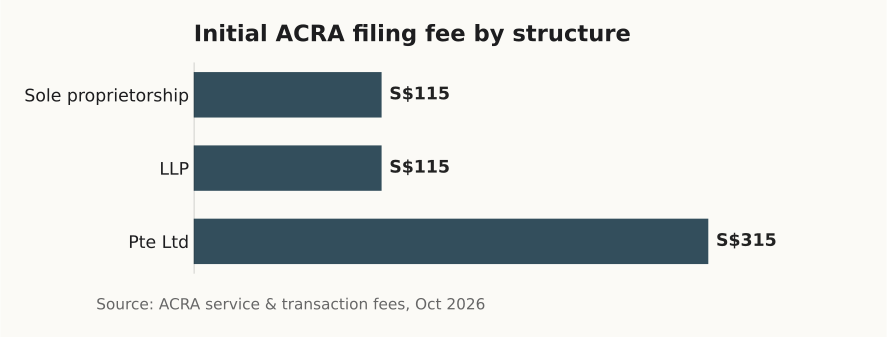
Initial ACRA filing fee (name application + registration). Totals include the S$15 name application fee; sole proprietorships require renewal. Graphic by StartBizSG, based on ACRA fees, as of October 2026.
| Structure | Separate legal entity | Liability | Taxed as | Ongoing ACRA obligation | ACRA set-up |
|---|---|---|---|---|---|
| Sole proprietorship | No | Unlimited | Personal income | Renew registration | ~S$115 |
| LLP | Yes | Limited (own wrongful acts excepted) | Each partner on its share (personal or corporate rates) | Annual solvency/insolvency declaration | ~S$115 |
| Pte Ltd | Yes | Limited | 17% corporate | Company secretary, annual return, audit if required | S$315 |
Note: S$115 and S$315 are initial government filing fees, not complete setup costs — company-secretary, registered-office, accounting, licence and professional fees may also apply.
Which should you choose?
A sole proprietorship suits a low-risk solo venture you are testing cheaply. An LLP suits two or more partners who want partnership-style management with liability protection but personal-rate taxation. A Pte Ltd suits founders who plan to hire, raise funds, or scale, and who want limited liability, the ability to issue shares to investors, and the corporate tax treatment. When you’re ready, see how to register a company, and if any owner is based overseas, read about setting up a foreign-owned company.
General information and official rules, not legal or tax advice. Your best structure depends on your situation — confirm with a qualified professional.
Sources
- Step 2: Choosing a business structure — Accounting and Corporate Regulatory Authority (as of October 2026)
- Service & transaction fees: Companies — Accounting and Corporate Regulatory Authority (as of October 2026)
- Corporate Income Tax Rate, Rebates & Tax Exemption Schemes — Inland Revenue Authority of Singapore (as of October 2026)