Corporate Secretary Requirement in Singapore Explained

Every Singapore company must appoint a company secretary within six months of incorporation, and the role cannot stay vacant for over six months (a breaching director may be fined up to S$1,000). The secretary must be a natural person resident in Singapore, not debarred under s155B, and cannot be the sole director. File changes within 14 days.
The company secretary is a statutory officer, not an optional hire. Every Singapore company must appoint one within six months of incorporation, and keep the role filled — this applies to one-person startups just as much as to larger firms.
The timing rule
You have six months from incorporation to appoint a secretary, and after that the office cannot be left vacant for more than six months at any one time. A director who lets the role lapse may face a fine of up to S$1,000. This six-month vacancy period is a legal maximum, not a recommended grace period — operationally you should appoint a replacement before an outgoing secretary leaves, so no gap arises.
Who can be the secretary
Under the Companies Act, a company secretary must:
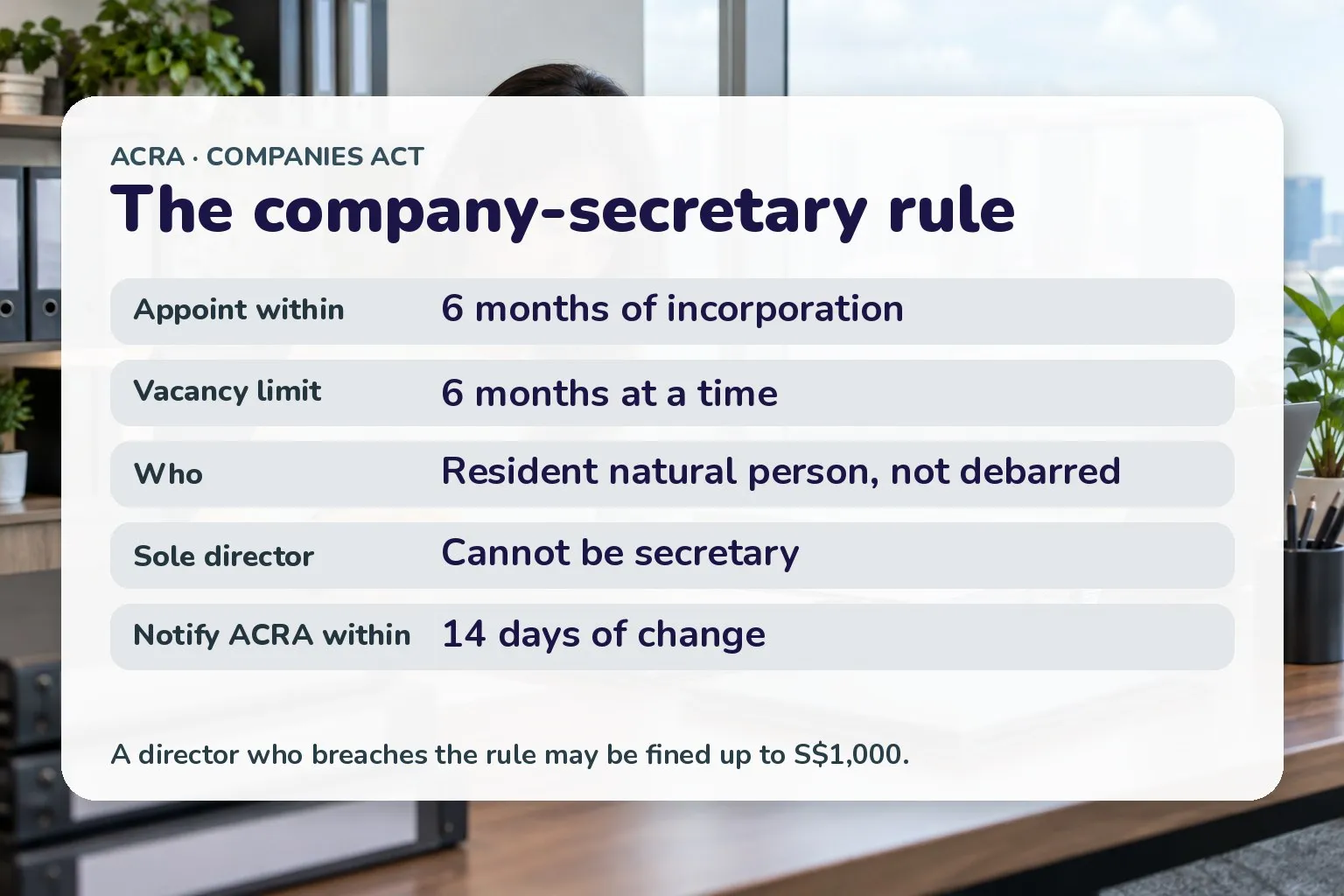
The core company-secretary requirements. Graphic by StartBizSG, based on ACRA and the Companies Act, as of October 2026.
- be a natural person (not a company);
- have their principal or only place of residence in Singapore — commonly a citizen or permanent resident; a FIN or pass holder should first confirm with MOM or ICA that they may accept the appointment;
- not be debarred from acting as a secretary under section 155B of the Companies Act; and
- not be the sole director of the company. If your company has only one director, that person cannot also be the secretary.
The appointee must also file the prescribed consent to act when appointed. Once a company has two or more directors, one of them may also act as secretary — but the same person cannot satisfy a requirement that legally needs separate action by a director and the secretary (section 171(5)).
Qualifications
For a private company the Act does not prescribe a formal qualification. Instead, the directors must take reasonable steps to ensure the appointee has the knowledge and experience to do the job. (Public companies face stricter qualification rules.) In practice many SMEs outsource the role to a corporate service provider, which is common and perfectly acceptable — especially for foreign-owned companies whose founders are not resident here.
What the secretary does
The secretary keeps the company compliant: maintaining the statutory registers and company information, organising meetings and minutes, reminding directors of filing deadlines, and lodging changes with ACRA. That includes keeping you on track for your AGM and annual return. Any appointment, withdrawal or change of secretary particulars must be filed on BizFile within 14 days; most such transactions require the affected person to endorse them, and appointing or withdrawing a foreign position holder generally requires additional verification. ACRA does not charge a fee for the filing itself. The secretary helps maintain records and compliance, but the directors remain legally responsible for the company’s compliance and cannot delegate that responsibility away.
Fitting it into setup
Appointing the secretary is one of the first things to sort after you register your company — ideally well inside the six-month window, alongside noting your financial year end so the first annual filings are easy to meet.
General information and official rules, not legal advice. Check ACRA and the Companies Act for the requirements that apply to your company.
Sources
- Choosing company directors & other key officers — Accounting and Corporate Regulatory Authority (as of October 2026)
- Companies Act 1967, section 171 — Singapore Statutes Online (AGC) (as of October 2026)
- Companies Act 1967, section 155B (debarment) — Singapore Statutes Online (AGC) (as of October 2026)