Annual Filing in Singapore: AGM and Annual Return

Every live Singapore company must file an annual return — a non-listed company within 7 months after financial year end. It must also hold an AGM within 6 months after FYE unless an exemption applies or a private company has dispensed with AGMs. Filing late costs S$300 (up to 3 months) or S$600 (over 3 months). A private 'small company' is exempt from audit.
Every live Singapore company must file an annual return with ACRA each year. It must also hold an Annual General Meeting (AGM) unless an exemption applies or a private company has validly dispensed with AGMs. Both deadlines are now tied to your financial year end (FYE).
The two deadlines
For a company that is not listed:
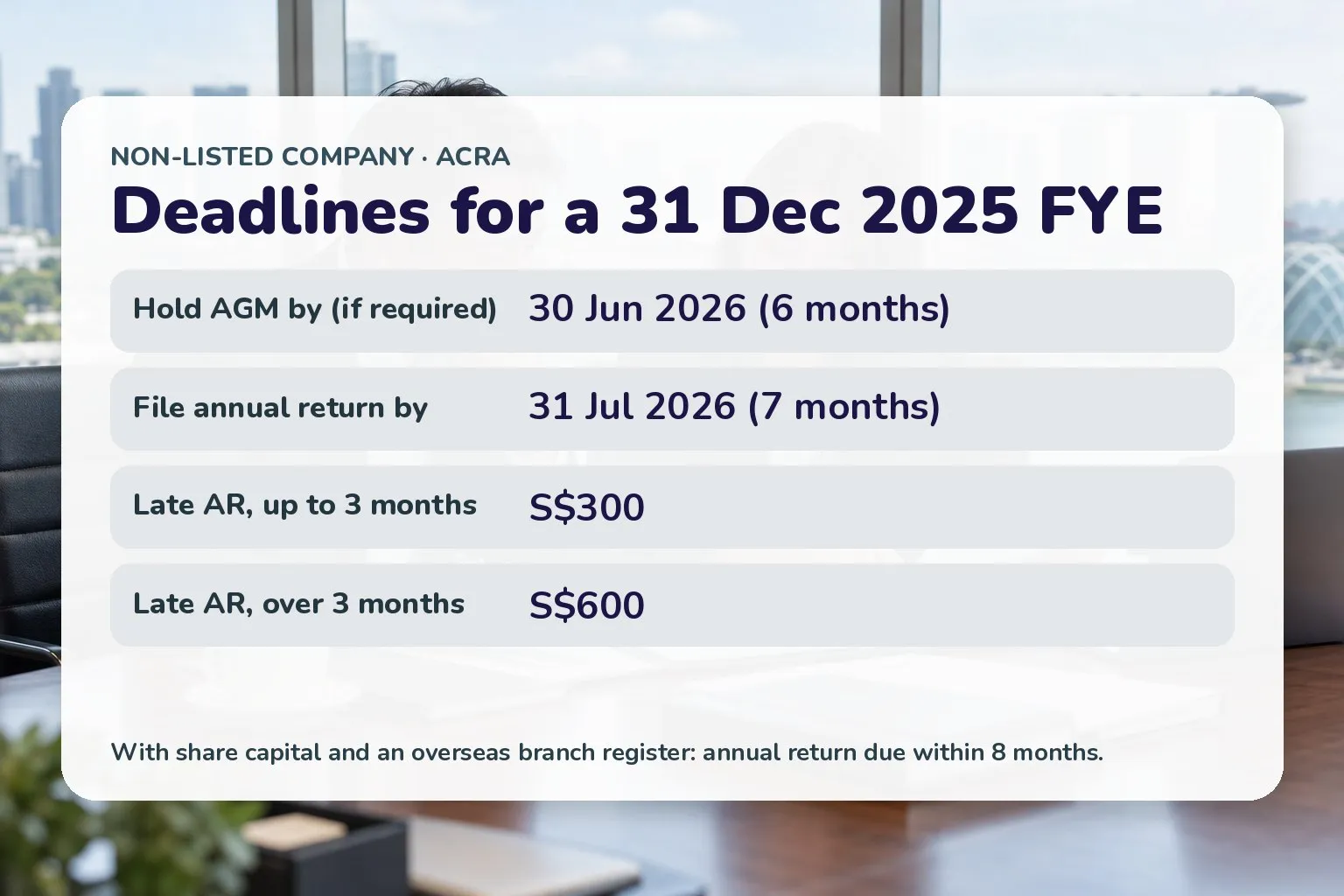
AGM and annual-return deadlines for a non-listed company. Graphic by StartBizSG, based on ACRA guidance, as of October 2026.
- Hold the AGM within 6 months after FYE (listed companies: 4 months).
- File the annual return within 7 months after FYE (listed companies: 5 months). If the company has share capital and keeps a branch register outside Singapore, the annual return is due within 8 months.
So a company with a 31 December 2025 FYE must hold its AGM by 30 June 2026 and file its annual return by 31 July 2026. You declare the AGM details when you file the annual return on BizFile.
When you can skip the AGM
A private company need not hold an AGM if: all members have approved a resolution to dispense with AGMs; or the company sends its financial statements to members within 5 months after FYE; or it is a private dormant relevant company exempt from preparing financial statements. A member or auditor can still require a meeting within set timeframes.
Late-filing penalties
File the annual return after the due date and ACRA imposes a late lodgement penalty, applied automatically on BizFile: S$300 if up to three months late, and S$600 if more than three months late. These bands are separate from the ordinary S$60 annual-return filing fee. You can apply for up to 60 additional days (S$200) before the deadline if you need more time. A late AGM often leads to a late annual return, and ACRA can take separate enforcement action — so diarise both deadlines.
Do you need an audit?
Many small companies don’t. A company qualifies for audit exemption as a small company if it is a private company and meets at least two of three criteria for the immediate past two consecutive financial years: total annual revenue ≤ S$10 million, total assets ≤ S$10 million, and ≤ 50 employees. A newly incorporated company with fewer than two financial years is assessed using each applicable current financial year instead. If the company belongs to a group, the company itself must qualify as a small company and the entire group — including foreign entities — must meet at least two of the three thresholds on a consolidated basis. The small-company audit exemption does not itself remove the duty to prepare financial statements or file the annual return, though a separate exemption may apply to a dormant relevant company.
Keeping on top of it
These filings are usually handled by your company secretary, whose job includes reminding directors of deadlines. They sit alongside your corporate tax obligations (including the ECI). If you’ve just registered, note your FYE now so the first AGM and annual return don’t creep up on you.
General information and official rules, not legal or accounting advice. Check ACRA for the deadlines and exemptions that apply to your company.
Sources
- AGM and annual return breaches (overview) — Accounting and Corporate Regulatory Authority (as of October 2026)
- Penalties & enforcement action: Late annual return filing — Accounting and Corporate Regulatory Authority (as of October 2026)
- Audit exemptions: Small company concept — Accounting and Corporate Regulatory Authority (as of October 2026)