Opening a Business Bank Account in Singapore (2026)

For most new companies the lowest-cost pick is the ANEXT Business Account — no minimum balance, no monthly or fall-below fees — but it is a digital wholesale bank with no SDIC deposit insurance. For a traditional, SDIC-insured bank, OCBC's Business Growth Account is the best low-entry option.
On this page9 sections · tap to jump
- 01Quick verdict
- 02What you need to open an account
- 03The whole market, compared
- 04The fee that actually costs you: fall-below
- 05Digital banks: ANEXT and Green Link
- 06Not a bank: Aspire, Wise, Airwallex
- 07Deposit insurance (SDIC): what is and isn’t covered
- 08Foreign-owned companies: harder, dearer
- 09Who should not pick the winner
Once your company is registered, the next job is a business bank account — and for a new company the cheapest option is rarely the one with the lowest headline fee. What quietly drains a young company’s cash is the fall-below fee: miss the required average balance and you pay a monthly penalty whether or not you transact. This guide compares the whole market — the three local banks, two more traditional banks, and Singapore’s digital banks — on the figures that actually decide cost: initial deposit, minimum balance, fall-below fee and SDIC cover.
Quick verdict
- Overall lowest cost (most startups): ANEXT Business Account. No minimum balance, no monthly fee and no fall-below fee, plus up to 0.8% p.a. daily interest. The catch: it is a digital wholesale bank, so balances are not SDIC-insured.
- Best traditional, SDIC-insured bank (runner-up overall): OCBC Business Growth Account. S$1,000 to open, a low S$1,000 minimum average balance, S$20/month fall-below fee, S$10 monthly fee (first two months free), and 80 free FAST + 80 free GIRO transfers a month.
- No balance pressure at a full bank: CIMB SME Account. No minimum balance and no fall-below fee at any stage, with free local transfers; a monthly fee applies after the first year.
- Multi-currency / cross-border trade: DBS Business Multi-Currency Account. Holds 13 currencies; its Starter Bundle is free of a service charge for companies under three years old. For cheap international transfers specifically, ANEXT’s flat S$15 outward transfer is hard to beat.
- If you will hold meaningful working capital: UOB eBusiness Account. Just S$35 a year if you keep the S$5,000 average daily balance — the lowest ongoing fee of the local banks at that level.
What you need to open an account
Every provider here lets a Singapore-registered company apply online with Singpass/Corppass and your UEN. You will generally need your company’s registration details, the constitution, and identification for the directors and authorised signatories. Instant or same-day opening is usually reserved for companies wholly or majority owned by Singapore citizens or PRs; other ownership structures are routed to manual review (more on that below). If you have not incorporated yet, start with how to register a company in Singapore, and note that a resident company secretary must be appointed within six months regardless of which bank you choose.
The whole market, compared
The table shows each account’s published entry cost and the balance you must keep to dodge the fall-below fee. “SDIC” marks whether eligible Singapore-dollar deposits are covered by deposit insurance.
| Account | Initial deposit | Min. average balance | Fall-below fee | Account fee | SDIC-insured |
|---|---|---|---|---|---|
| OCBC Business Growth | S$1,000 | S$1,000 | S$20/mo | S$10/mo (2 mo waived) | Yes |
| UOB eBusiness | S$1,000 | S$5,000 | S$15/mo (waived 12 mo) | S$35/yr | Yes |
| DBS Business Multi-Currency — Starter (under 3 yrs) | Not stated | None | — | S$10/mo | Yes |
| DBS Business Multi-Currency — standard (over 3 yrs) | Not stated | S$10,000 | S$40/mo | S$50/yr | Yes |
| Maybank FlexiBiz | S$1,000 | S$1,000 | S$10/mo | None | Yes |
| CIMB SME Account | None | None | None | None first 12 mo | Yes |
| ANEXT Business Account | None | None | None | None | No (wholesale) |
| Green Link Current Account | Not stated | No min-balance fee | None | Not stated | No (wholesale) |
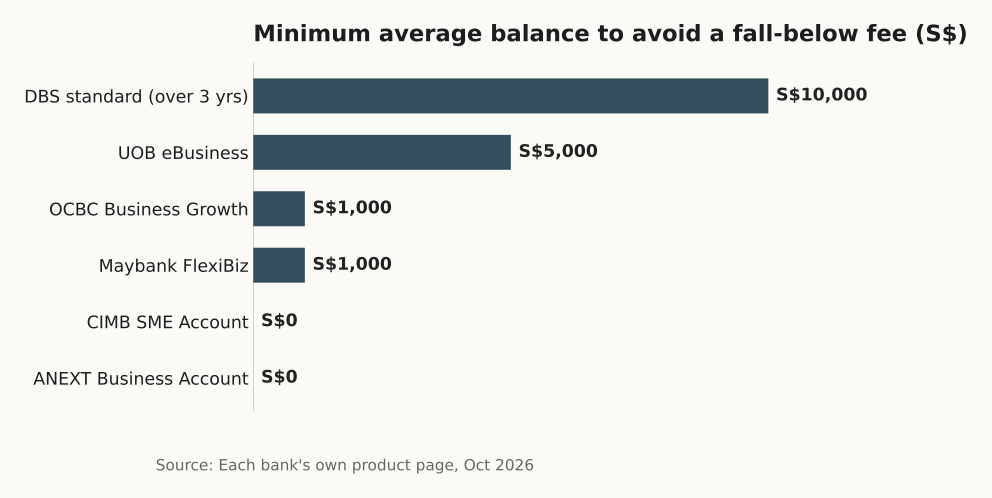
Minimum average balance to avoid a fall-below fee, by account. Source: each bank’s own product page, as of October 2026.
The fee that actually costs you: fall-below
Headline account fees cluster in a narrow band — S$0 to S$50 a month or S$35–50 a year. The figure that varies most, and bites hardest on a lean startup, is the minimum balance you must average to avoid a fall-below charge:
- OCBC Business Growth asks the gentlest of the local banks: a S$1,000 monthly average, with a S$20/month fee below it. (If you switch on its interest-rate promotion, a separate S$50/month fee applies below a S$50,000 average — so leave that off unless you hold large balances.)
- Maybank FlexiBiz matches the low S$1,000 floor with a smaller S$10/month fall-below fee and, unusually, no monthly account fee. FAST transfers cost S$0.50 each.
- UOB eBusiness expects a steeper S$5,000 average daily balance, with a S$15/month fee — but waives that fee for the opening month plus the next 11 months, so the trap only bites in year two. Its annual fee is just S$35, and incoming PayNow is free until 31 December 2028.
- DBS Business Multi-Currency charges a S$40/month service charge unless you hold a S$10,000 average daily balance — but companies under three years old can take the Starter Bundle: a flat S$10/month, no minimum balance, and unlimited free FAST/GIRO via DBS IDEAL. Plan to migrate before the third birthday.
- CIMB SME Account sidesteps the whole problem: no minimum balance and no fall-below fee at any stage, with free unlimited FAST, GIRO, PayNow and payroll via BizChannel@CIMB. Its monthly fee is waived for the first 12 months; a flat monthly fee applies afterwards (check CIMB’s current pricing for the exact figure).
Digital banks: ANEXT and Green Link
Singapore has two digital wholesale banks, both licensed by MAS to serve SMEs: ANEXT Bank (a subsidiary of Ant International) and Green Link Digital Bank. They are genuine banks under the Banking Act — not fintech apps — but the “wholesale” licence means they serve businesses, not retail consumers.
ANEXT is the standout for cost: no initial deposit, no fall-below fee, no annual fee, and up to 0.8% p.a. daily interest on SGD, USD and EUR balances. It holds SGD, USD, CNH and EUR, offers unlimited free local transfers and free inbound telegraphic transfers, and charges a flat S$15 for outgoing international transfers. You apply fully online with Corppass/MyInfo Business; a business can hold one ANEXT account. Green Link runs a digital current account with no minimum-balance fee and credit interest; it publishes fewer headline fees, so check GLDB directly for current pricing.
Not a bank: Aspire, Wise, Airwallex
You will see Aspire, Wise, Airwallex, Revolut Business and similar apps marketed as “business accounts”. They are useful, but they are not banks. In Singapore they operate as Major Payment Institutions under the Payment Services Act — for example, Aspire holds MAS in-principle approval for a Major Payment Institution licence. A payment institution must safeguard customer money in segregated accounts, but that is not deposit insurance: there is no SDIC cover, and recovery in a failure depends on the safeguarding arrangement, not a state scheme. They can be excellent for FX and cross-border payouts alongside a bank account — just do not mistake them for one, and read the safeguarding terms.
Deposit insurance (SDIC): what is and isn’t covered
The Singapore Deposit Insurance Corporation insures eligible Singapore-dollar deposits — savings, current and fixed — up to S$100,000 in aggregate per depositor per Scheme member. Companies and other non-bank depositors are covered where their deposits are eligible. Three limits matter for a business:
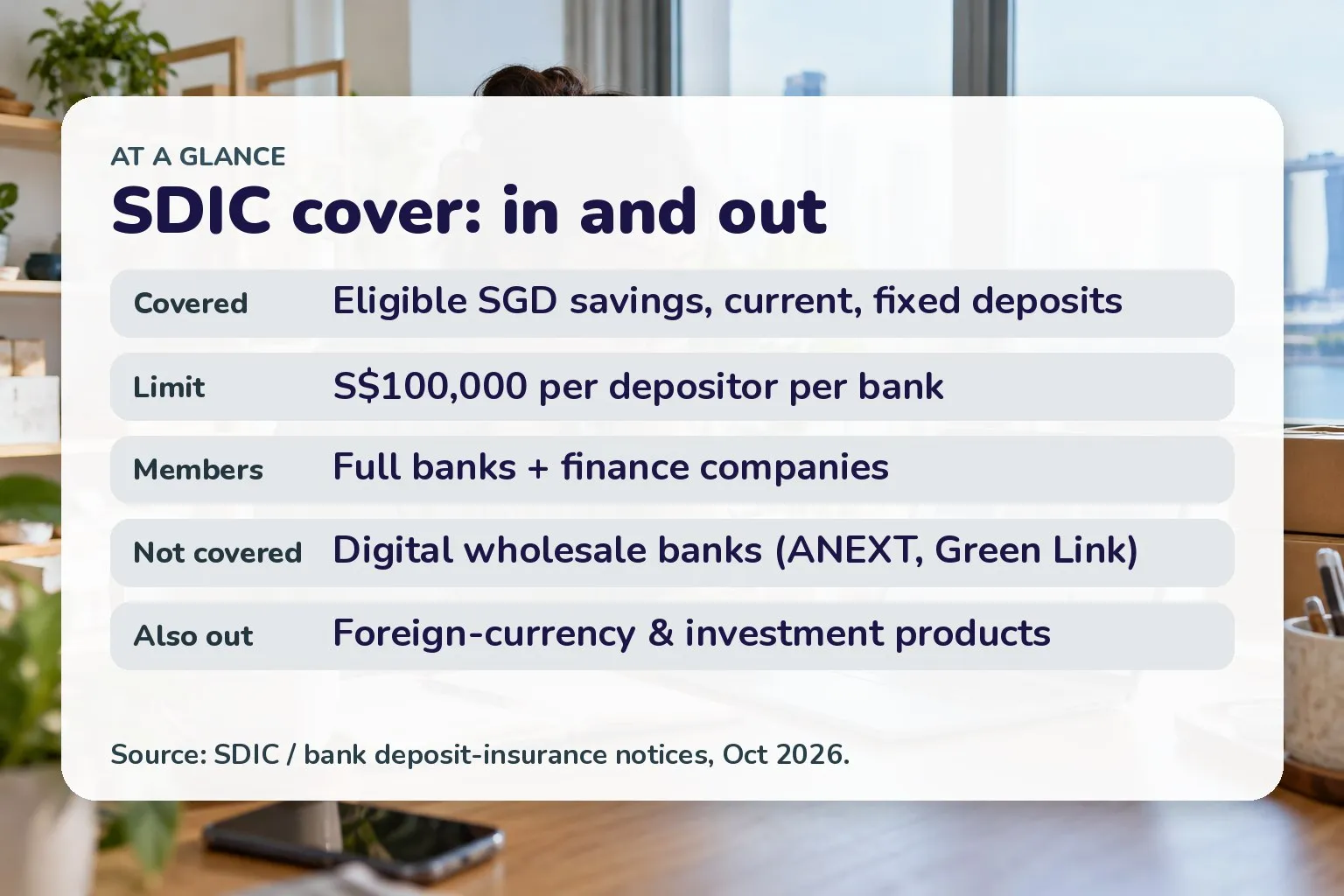
What deposit insurance does and does not cover for a business. Source: SDIC and bank deposit-insurance notices, as of October 2026.
- Scheme membership applies to full banks (including the digital full banks) and finance companies — not digital wholesale banks like ANEXT and Green Link.
- Foreign-currency deposits, structured deposits and investment products are not covered, even at a full bank — so a multi-currency balance is outside the net.
- The S$100,000 cap is per bank, aggregated across your accounts at that institution.
Foreign-owned companies: harder, dearer
If no owner or director is a Singapore citizen or PR, expect a slower path. Instant online opening at OCBC, UOB and DBS is built around majority SC/PR ownership; other structures are pushed to manual review. Setup fees climb too — UOB charges from S$500 for foreign-incorporated companies, and DBS’s account set-up fee for non-standard cases runs into the thousands. ANEXT requires a Singapore-incorporated business with an active Corppass, and may ask non-SC/PR controllers for extra documents. For the fuller picture on structuring and nominee-director rules, see our guide to foreign-owned companies in Singapore.
Who should not pick the winner
ANEXT’s zero-fee account suits most early-stage companies, but skip it if you want SDIC-insured deposits, need to hold large cash reserves safely, rely on branch service or cheque handling, or need currencies beyond SGD/USD/CNH/EUR. In those cases a full bank — OCBC Business Growth for a low entry point, DBS Multi-Currency for 13-currency trade, or CIMB SME for no balance pressure with SDIC cover — is the sounder choice. If your turnover will cross S$1 million, you will also soon be dealing with GST registration, so pick a bank whose reporting and transfer tools you can live with.
General information and official rules, not financial advice. Fees and balances change — confirm the current figures on each bank’s own pricing page before you apply.
Sources
- OCBC Business Growth Account — OCBC (as of October 2026)
- UOB eBusiness Account — United Overseas Bank (as of October 2026)
- DBS Business Multi-Currency Account — DBS Bank (as of October 2026)
- Maybank FlexiBiz Account — Maybank Singapore (as of October 2026)
- CIMB business banking (Singapore) — CIMB Singapore (as of October 2026)
- ANEXT Business Account — ANEXT Bank (as of October 2026)
- Green Link Digital Bank — business accounts — Green Link Digital Bank (as of October 2026)
- Licensing for Payment Service Providers — Monetary Authority of Singapore (as of October 2026)