EDGE Grant Singapore: What It Covers and How to Apply

EDGE is Enterprise Singapore's single, activity-based business grant, live since 30 September 2026. It replaced EDG, MRA and PSG. SMEs get up to 50% support (up to 70% for internationalisation and sustainability), capped at S$100,000 a company each year, reimbursed after the project.
If you have looked for SME funding in Singapore since late September 2026, you will have met one name: EDGE. It is Enterprise Singapore’s single, activity-based business grant, and since 30 September 2026 it is the way companies apply for mainstream business-grant support. EDGE replaced three familiar schemes — the Enterprise Development Grant (EDG), the Market Readiness Assistance (MRA) grant and the Productivity Solutions Grant (PSG) — folding them into one application route. This guide explains what EDGE actually funds, how much you can get, who qualifies, and the exact steps to apply.
What the EDGE Grant is
EDGE “streamlines EDG, MRA and PSG into a single grant”, in Enterprise Singapore’s words, so you no longer pick a named scheme and learn its separate rules — you pick the activity you want to do, and EDGE support follows. Despite the capital letters, EDGE is not an acronym; Enterprise Singapore says it simply conveys the intent of giving enterprises an edge over their competitors.
The three predecessor schemes ceased on 29 September 2026, and from 30 September no new application is accepted under them. If you are midway through an old EDG, MRA or PSG project, nothing is lost: ongoing submissions and approved projects continue under their original rules and you still claim on completion. For the history and transition detail, see our note on the Enterprise Development Grant’s closure and the move to EDGE. Everything below is about applying under EDGE for a new project.
The eight business areas EDGE covers
Enterprise Singapore groups EDGE support into eight business areas spanning over 150 activities. The areas you choose from are Automation & Digitalisation, Business Strategy, Financial Management, Innovation, Internationalisation, Standards and Sustainability — covering everything from automating operations and adopting digital solutions to entering overseas markets, adopting standards and building a more sustainable business.
EDGE is open to all industries. Some activities are generic — customer management, human-resource management, sales management, inventory tracking — while others are sector-specific, designed for retail, food, logistics, precision engineering and the built environment. Because the support rate, eligible costs, deliverables and project duration vary by activity, the single most important step before applying is to open the specific activity’s page on Enterprise Singapore’s website or the BizSG recommender and read its conditions. Our SME grant finder can help you narrow down a business area first.
How much EDGE pays
Funding support depends on the activity and on whether you are an SME:
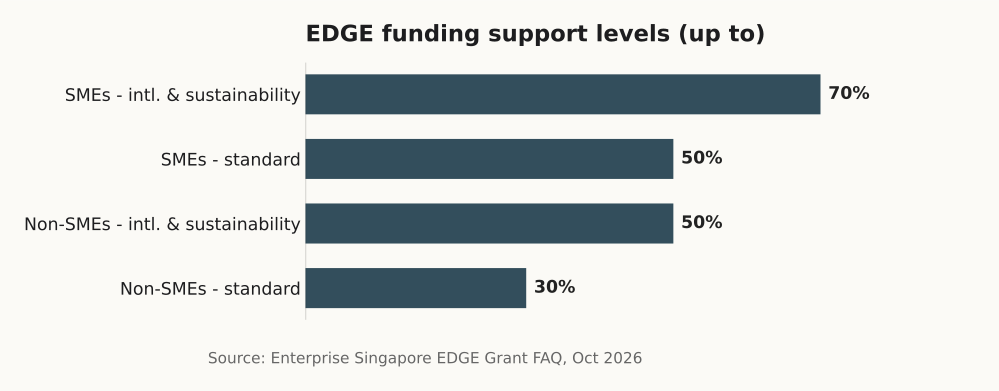
EDGE support levels by company type and activity. Source: Enterprise Singapore EDGE Grant FAQ, as of October 2026.
- SMEs: up to 50% of qualifying costs — rising to up to 70% for internationalisation and sustainability activities.
- Non-SMEs: up to 30% — rising to up to 50% for internationalisation and sustainability activities.
On top of the per-activity rate sits a company-level cap. Each company can receive up to S$100,000 a year across all eligible activities. The year runs from 1 April to 31 March and the cap resets each 1 April — unused headroom does not carry forward. Within that S$100,000, up to S$30,000 can go toward single-function digital solutions, integrated enterprise systems and pre-scoped equipment; the remainder is for larger activities such as market entry, innovation or capability projects.
If you exhaust the cap, you cannot draw further support until it refreshes in the next period. And if you terminate an approved project without claiming, that amount returns to your cap balance for the year it was approved in.
Who can (and cannot) apply
The core eligibility test is short but firm. The applicant must be:
- a business entity registered in Singapore; and
- held with at least 30% Singaporean and/or Singapore Permanent Resident ownership.
Other requirements may apply depending on the activity you pick. Just as important is who is excluded. EDGE supports Singapore-registered business entities only, so applications from non-profit organisations, societies, religious entities, voluntary welfare organisations, government statutory boards and government subsidiaries are rejected. A business registered overseas cannot apply either, even if it plans to expand into Singapore — it must first be registered here. If you are still at that stage, start with our guide on how to register a company in Singapore.
How to apply, step by step
EDGE is applied for through the Business Grants Portal (BGP), the same portal used across government grants. The flow is:
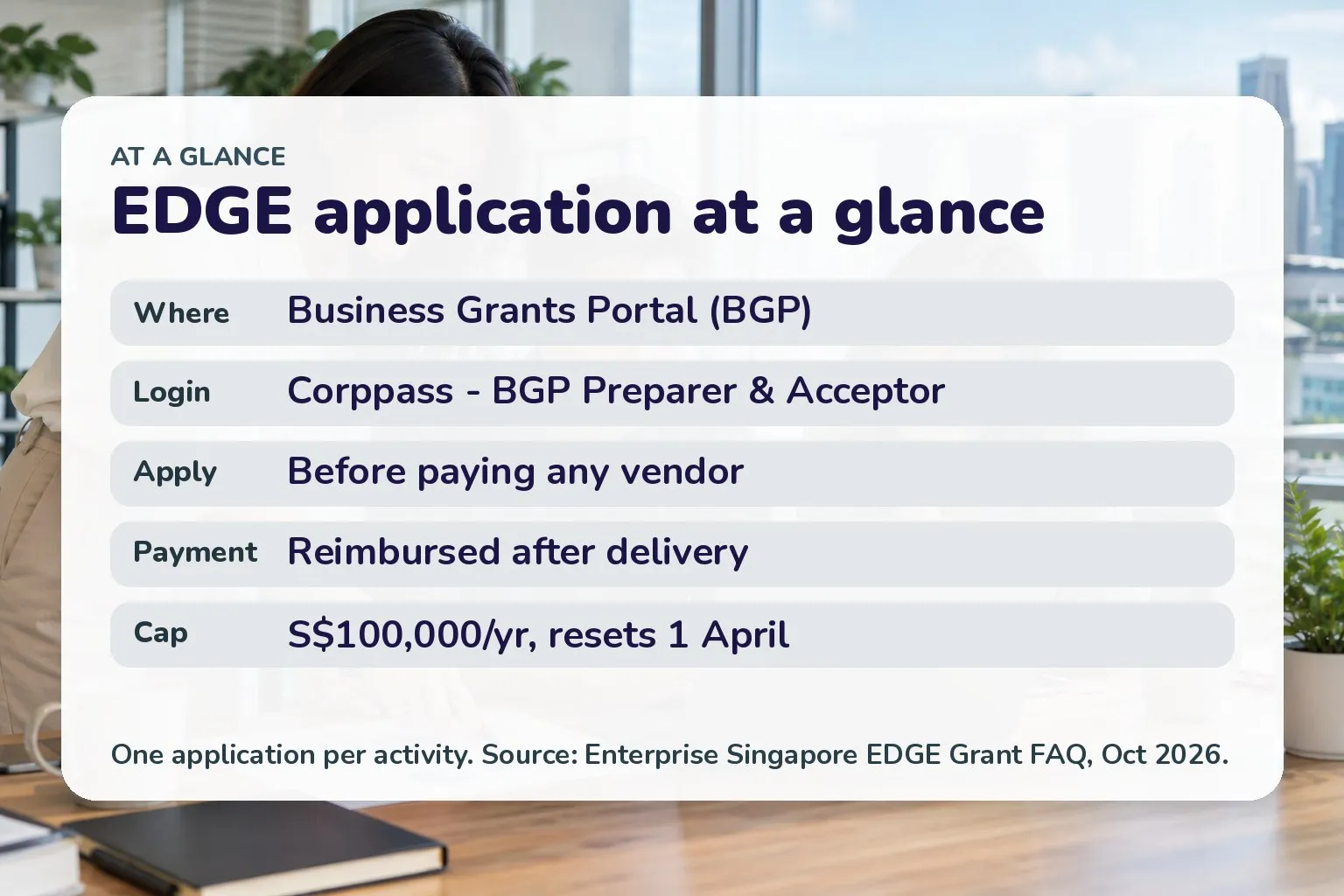
How an EDGE application works, at a glance. Source: Enterprise Singapore EDGE Grant FAQ, as of October 2026.
- Find your activity. Browse the supportable activities on Enterprise Singapore’s website or the BizSG recommender. Each activity page carries its own support level, eligible costs, deliverables and the BGP application link.
- Check eligibility and scope the work. Confirm the 30% local-ownership rule and any activity-specific conditions, and decide what deliverable you are buying. For single-function digital solutions you can browse vendors on the IMDA SMEs Go Digital platform.
- Set up Corppass roles. Only staff assigned the Corppass roles of BGP Preparer and BGP Acceptor can submit an EDGE application, so sort these out before you start.
- Submit on the BGP — before you pay. Apply through the activity’s BGP link. The applicant company must apply, pay and claim; a vendor or third party cannot do this on your behalf, and you must declare any relationship with the vendor.
- Deliver and claim. EDGE is reimbursement-based: you complete the project, then submit a claim, and support is disbursed after your deliverables and expenses are verified.
If you used EDG, MRA or PSG before
Past applicants are not shut out. Businesses that previously applied for or received EDG, MRA or PSG funding can apply for EDGE — but the new grant is for new projects, so you cannot seek EDGE support for a project already backed by the old schemes. Helpfully, your previous utilisation under EDG, MRA or PSG does not count against the EDGE caps; the S$100,000 and S$30,000 limits apply to EDGE applications only.
Two timing points matter. First, where an old-scheme programme used the SkillsFuture Enterprise Credit (SFEC), employers must submit final claims by 30 November 2026, and EDGE itself is not supportable under SFEC. Second, PSG administered by other agencies (outside Enterprise Singapore) is transitioning to EDGE in a phased timeline from November 2026; ongoing projects there continue until completion, but you may not be able to lodge new PSG claims during each agency’s switch.
Common questions
Can I run several EDGE activities at once? Yes. You submit one application per activity and may run several concurrently, all drawing on the single S$100,000 annual cap.
Can I stack EDGE with other government grants? Not for the same costs. Once another Enterprise Singapore or agency grant has approved a set of eligible expenses, EDGE cannot also fund them.
I need to change my project after approval — how? Enterprise Singapore’s design is to terminate the existing project on the BGP and submit a new application for the revised scope. Expenses on a terminated project are not claimable.
What if no EDGE activity fits my need? Approach an SME Centre for advice, toolkits and referrals to other, non-EDGE support — Enterprise Singapore points businesses there when a suitable activity is not listed.
Is the grant taxable? That depends on its purpose and how the spend is treated; see our note on corporate tax in Singapore and confirm the classification before you book it.
General information and official rules, not financial advice. Support rates, eligible costs and project durations are set per activity — check the activity’s own page on Enterprise Singapore or BizSG, and the EDGE FAQ, before you apply.
Sources
- EDGE Grant — Enterprise Singapore (as of October 2026)
- FAQ: EDGE Grant — Enterprise Singapore (as of October 2026)
- EDGE Grant & Productivity Solutions Grant (PSG) FAQ — GoBusiness Singapore (as of October 2026)
- SkillsFuture Enterprise Credit (SFEC) — Enterprise Singapore (as of October 2026)