ECI Filing in Singapore: What It Is and When to File

File your company's ECI with IRAS within 3 months of your financial year-end. You can skip it only if annual revenue is S$5 million or below and ECI is nil — otherwise you must file even if the estimate works out to zero.
Estimated Chargeable Income (ECI) is your company’s own estimate of its taxable profit for a Year of Assessment, and IRAS wants it within 3 months of your financial year-end. You can skip the filing only when your annual revenue is S$5 million or below and your ECI is nil. Miss both of those, and you file — even if the final figure is zero.
What ECI actually is
ECI is an estimate of your company’s taxable profits after deducting tax-allowable expenses, declared for a Year of Assessment (YA). It is not the same as your final tax return: you lodge ECI early, then file the detailed corporate tax return (Form C-S, Form C-S (Lite) or Form C) later in the year. Think of ECI as the first, provisional number that lets IRAS raise an early assessment and start any instalment plan.
One point trips up new founders: the ECI you declare should be the amount before deducting the partial tax exemption or the start-up exemption. IRAS computes and applies those exemptions for you automatically, so you don’t net them off yourself.
The 3-month deadline
Every company must file ECI within three months from the end of its financial year, unless it qualifies for the waiver or sits in a specifically exempt category (below). IRAS normally sends a reminder in the last month of your financial year, but the duty to file stands even if no notification arrives.
A December year-end therefore means an end-of-March deadline; a June year-end means an end-of-September one. Your deadline follows your own financial year, not a fixed national date.
The filing waiver: revenue and a nil ECI
You do not have to file ECI for a YA when both of these are true:
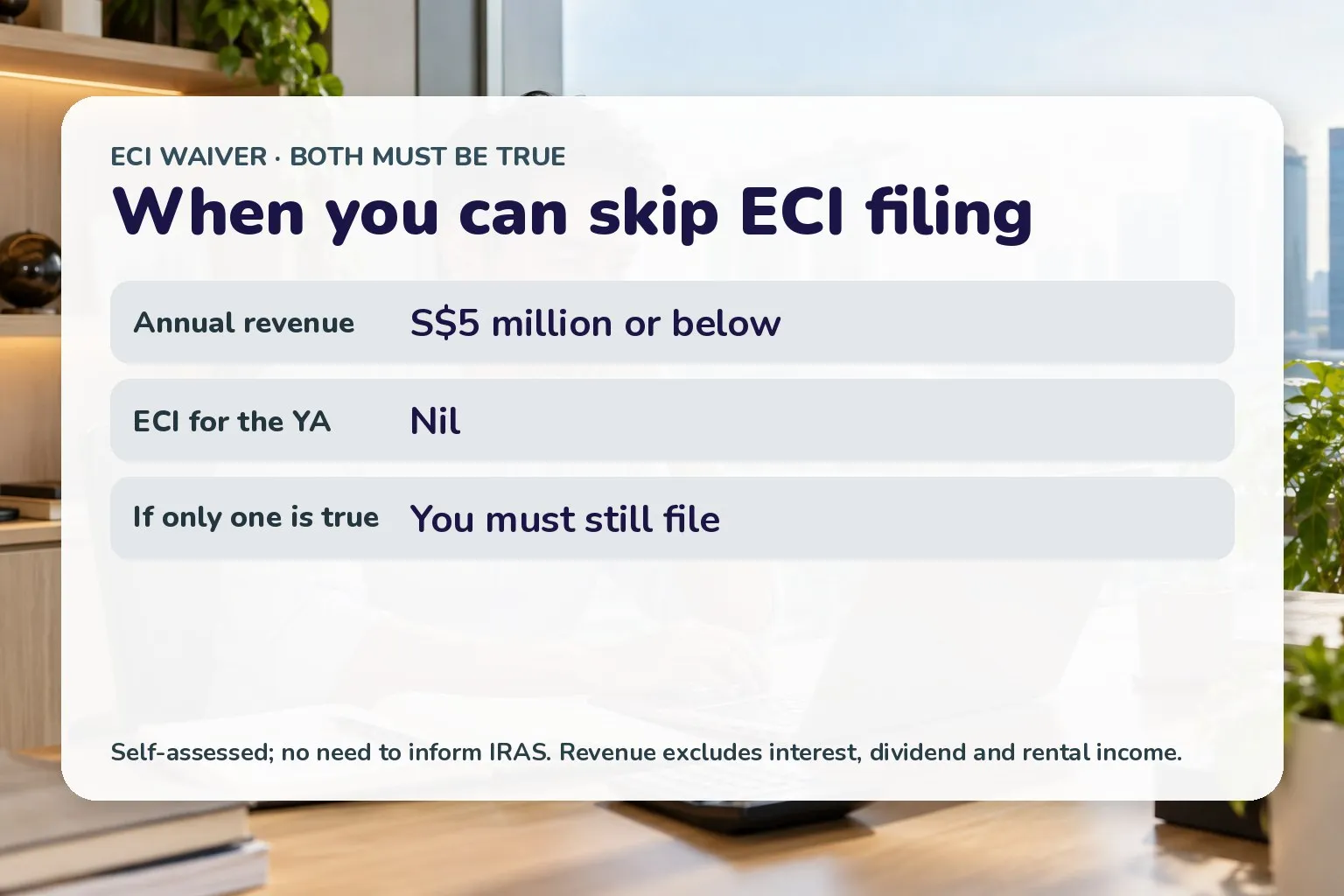
The two conditions that must both be met to skip ECI filing. Source: IRAS, as of October 2026.
- Annual revenue is S$5 million or below for that financial year; and
- ECI is nil for the YA.
Here, “revenue” means your main source of income — your principal trading income. It excludes separate-source income such as interest, dividends and rental. For an investment holding company, revenue is its investment income (for example, dividend and interest income).
IRAS publishes a short worked example for a company with a 30 June financial year-end:
| Revenue | ECI | Must file? |
|---|---|---|
| S$5 million | S$100,000 | Yes |
| S$10 million | Nil | Yes |
| S$5 million | Nil | No |
Only the company with revenue at or below S$5 million and a nil ECI is off the hook. A positive ECI, however small, means you file; revenue above S$5 million means you file even with a nil estimate (you can enter the chargeable income as “0” in the digital service).
Companies that don’t need to file ECI
Separately from the revenue/nil test, a few entity types are not required to file ECI at all, including:
- Foreign ship owners or charterers whose local shipping agent files the Shipping Return;
- Foreign universities;
- Designated unit trusts and approved CPF unit trusts;
- Real estate investment trusts granted treatment under Section 43(2) of the Income Tax Act 1947;
- Cases specifically granted an ECI waiver by IRAS.
Most SMEs won’t fall into these; they rely on the revenue-and-nil waiver instead.
File early to spread the tax into instalments
If you do file and have tax to pay, filing early is worth it. When your company is Singapore-registered and on GIRO, the number of monthly instalments depends on how soon you file — and you must file by the 26th of the qualifying month to get the full count:

Number of GIRO instalments granted by how early ECI is filed. Source: IRAS, as of October 2026.
The minimum monthly GIRO deduction is S$50, and the first instalment may be combined with the second depending on your exact filing date. To sketch your likely bill before you file, try our corporate tax estimator.
What happens if you miss it
If your company is required to file but doesn’t within the three months, IRAS may issue an estimated Notice of Assessment based on your past years’ income or other information it holds. That tax is payable in full within one month of the notice, with no instalment plan, and late-payment penalties and enforcement can follow. You can object within two months, but you must still pay the estimated amount first; any overpayment is refunded once the assessment is revised.
After you file
ECI is the early checkpoint; the full return and your annual filing with ACRA still follow. If the chargeable income in your later Form C-S/C differs from the ECI, IRAS refunds any excess automatically or asks for the shortfall within a month. For YA 2026, a 50% corporate income tax rebate (capped at S$40,000) is applied automatically from the figures you file, so an accurate ECI feeds straight into the relief you receive.
General information on official rules, not tax advice. Check IRAS for the current ECI requirements and confirm your own position before filing.
Sources
- Estimated Chargeable Income (ECI) Filing — Inland Revenue Authority of Singapore (as of October 2026)
- Corporate Income Tax Rate, Rebates & Tax Exemption Schemes — Inland Revenue Authority of Singapore (as of October 2026)